
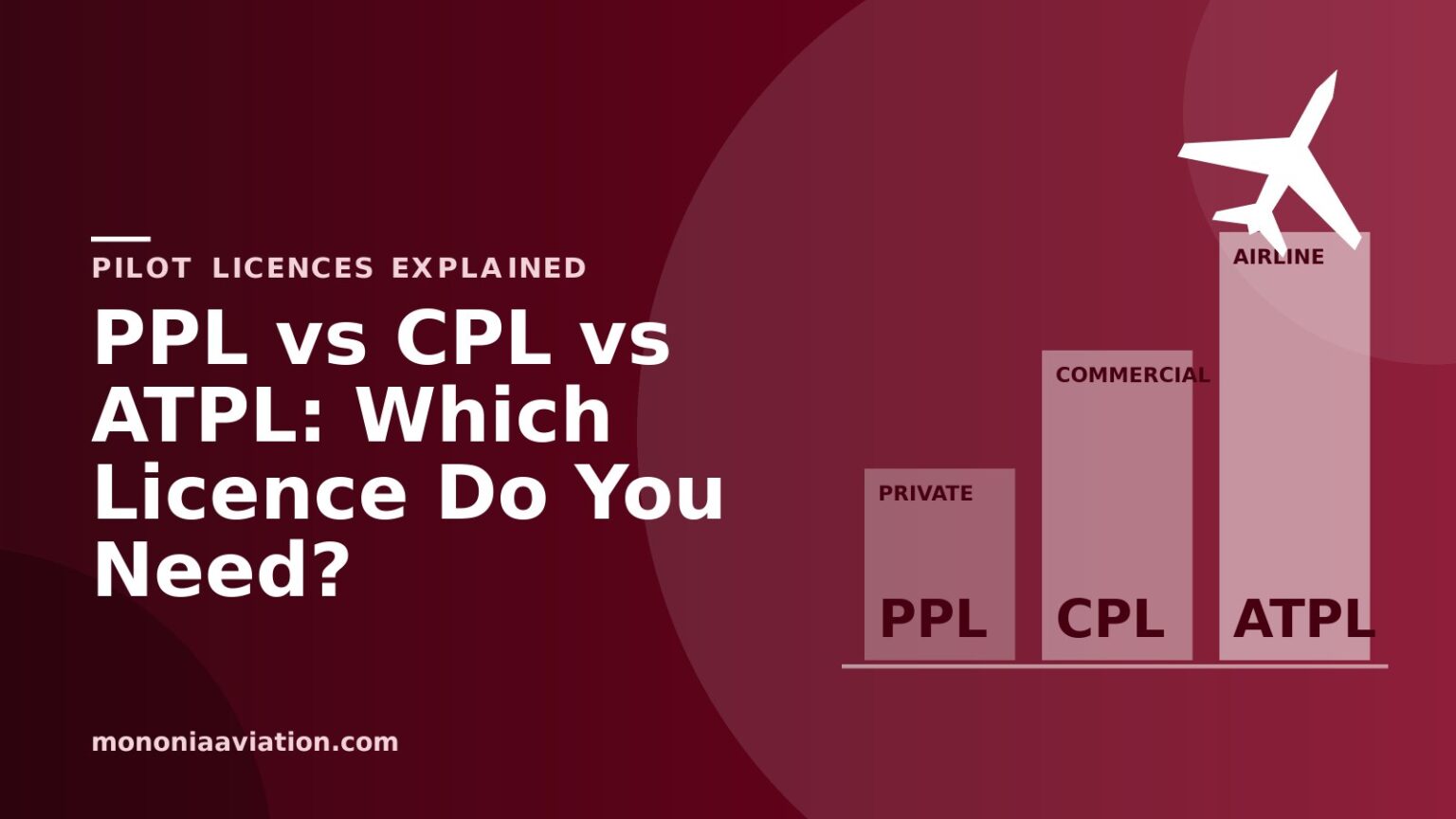
PPL vs CPL vs ATPL is one of the first questions every aspiring pilot asks. The three licences form a ladder, and each rung unlocks different flying privileges. Choosing the right one saves you time, money and effort.
In Nigeria, the Nigerian Civil Aviation Authority (NCAA) issues and validates these licences under regulations aligned with ICAO standards. This guide explains what each licence allows, who it suits and how to decide.
The quick answer
- PPL (Private Pilot Licence): fly for pleasure, without payment.
- CPL (Commercial Pilot Licence): fly professionally and get paid.
- ATPL (Airline Transport Pilot Licence): the highest level, needed to command large airliners.
PPL vs CPL vs ATPL at a glance
| Feature | PPL | CPL | ATPL |
|---|---|---|---|
| What it allows | Non-commercial flying with no payment | Paid flying, such as charter, aerial work and airline co-pilot roles | Command of multi-crew airliners |
| Typical minimum age | 17 | 18 | 21 |
| Medical class | Class 2 | Class 1 | Class 1 |
| Typical flight experience | Around 40 hours | 200 hours, or 150 on an approved integrated course | 1,500 hours |
| Best for | Hobby flying and a first step | Professional pilots | Airline captains |
The ages and hours above reflect ICAO minimums, which national rules follow. Schools and employers may ask for more. Always check the current Nigeria Civil Aviation Regulations and the NCAA advisory circulars before you plan your training.
What is a Private Pilot Licence (PPL)?
The PPL is the foundation of most pilot careers. It lets you fly aircraft for personal, non-commercial purposes. You cannot be paid for flying with a PPL.
Training covers your first solo flight, navigation, radio communication and emergency procedures. The NCAA requires a Class 2 medical certificate from an Authorised Aviation Medical Examiner for this licence.
A PPL suits people who want to fly for recreation. It is also the first milestone for pilots who take the modular route to a professional licence.
What is a Commercial Pilot Licence (CPL)?
The CPL is the licence that lets you work as a pilot. Typical roles include charter flying, aerial work, corporate flying and first-officer positions. Most commercial pilots also hold two additional ratings:
- Instrument rating (IR): lets you fly in cloud and low visibility by reference to instruments.
- Multi-engine rating (ME): lets you fly aircraft with more than one engine.
Employers set clear expectations. Recruitment listings for Nigerian airlines typically ask for a valid NCAA-issued or validated CPL or ATPL and a current Class 1 medical. Airline roles usually also need a type rating and multi-crew training.
What is an Airline Transport Pilot Licence (ATPL)?
The ATPL is the highest level of pilot licence. It is required to act as pilot in command of a multi-crew commercial aircraft. Under ICAO standards, it typically requires a minimum age of 21, around 1,500 hours of flight experience and a full set of ATPL theory exams.
In many systems, pilots complete the ATPL theory early and receive the full licence once they have built enough hours. In the PPL vs CPL vs ATPL comparison, hours are the biggest difference. ATPL programmes therefore combine theory, simulator training and long-term experience building.
Mononia Aviation’s Air Transport Pilot Licensing programme is designed around this path, with flight simulators and licensed instructors supporting trainees from foundation skills to advanced operations.
PPL vs CPL vs ATPL: which licence do you need?
The right choice depends on what you want to do with your licence. Use this guide:
- I want to fly for fun: a PPL is enough.
- I want an airline career: work towards a CPL with instrument and multi-engine ratings, then build experience towards an ATPL.
- I want charter or corporate flying: aim for a CPL with the ratings your target operators require.
- I want to command airliners: plan for the ATPL, and treat the CPL as a stepping stone.
- I am not sure yet: book a medical and an introductory flight, then decide.
Do you need a PPL before a CPL?
Not always. There are two common training routes.
- Modular route: you earn a PPL first, then add ratings and complete your commercial licence in stages. This gives you flexibility in how and when you train.
- Integrated route: you follow one structured programme from the start to a commercial licence. This is usually more intensive and more tightly scheduled.
Both routes lead to the same licence. Choose according to your schedule, your funding pattern and the approval status of the school.
How the NCAA fits in
Whichever side of the PPL vs CPL vs ATPL decision you land on, the same regulator applies. Four points are worth knowing:
- Medicals must come from an authorised aviation medical examiner.
- The NCAA knowledge test pass mark is 75%, and results stay valid for 24 months.
- The NCAA converts or validates only licences from ICAO states that meet the required standards.
- The NCAA publishes a list of approved training organisations, which you should check before you enrol.
Common mistakes when choosing a licence
Avoid these errors when you compare PPL vs CPL vs ATPL options:
- Starting flight training before you hold a valid medical.
- Assuming a PPL allows you to earn money from flying.
- Choosing a school without checking its approval status.
- Letting your knowledge test results expire before you finish training.
- Joining a programme without understanding the hours you still need afterwards.
Frequently asked questions
Can a PPL holder earn money from flying?
No. A PPL allows non-commercial flying only. You need a commercial licence to be paid as a pilot.
Do I need an ATPL to fly for an airline in Nigeria?
Not at the start. A CPL with the right ratings can open first-officer roles, subject to each employer’s own requirements. Command of a large airliner is the point where ATPL-level experience becomes essential.
How much does each licence cost?
Costs vary by school, aircraft and route, so we do not publish a single figure. Ask any school for an itemised written quote that covers tuition, flight and simulator hours, exams, medical and licensing fees.
Related reading
New to the topic? Start with our guide on how to become a pilot in Nigeria. To explore other roles, read about aviation careers in Nigeria beyond the cockpit.
Choose your licence path with confidence
Understanding PPL vs CPL vs ATPL is the first step. The next is speaking with a training team that can explain the options clearly. Contact Mononia Aviation to discuss your goals, entry requirements and upcoming intakes.


